
Artificial Intelligence
Isn't Cool

Because something is happening here
But you don’t know what it is
Do you, Mister Jones?—Ballad of a Thin Man, Bob Dylan, 1965
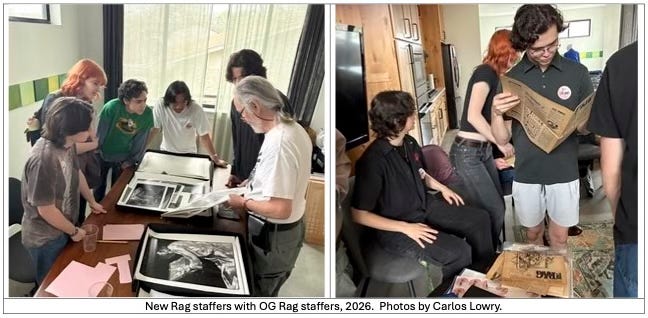
I knew something was happening when we had a gathering of original underground newspaper staffers with the Gen Z contributors to the contemporary Rag. The Gen Z generation weren’t scrolling on their phones.
My husband took photos on his phone. When he looked at them later, he noticed, “I was the only person using my phone.”
There was actual conversation happening. Animated, interesting conversation. The little zine published by the new Rag staffers has cartoon drawings and comes out in print! They do have a Substack site, but I’m collecting the colorful print versions.
Artificial Intelligence: Criminal Intent

I got my grandson to help me with the graphic for my Substack on AI. My Substack post focused on an AI intrusion into traditional Medicare. A pilot program in six states, including Texas, is using an AI contractor to pre-authorize medical treatments for Medicare recipients. [See updates below on Congressional backlash.]
There is a rising tide of backlash to AI. It’s popping up when communities fight back against data centers that will be greedy consumers of local energy and water. It’s popping up when graduating classes boo speakers mentioning AI. In Austin, there is a campaign to stop an Automated License Plate Reader contract. Organizers don’t trust how data will be used. It might be used against immigrants. It might be used to gather information on those seeking reproductive medical attention.
AI May Be Powerful but It’s Not Cool
Catherine Thorbecke is a Bloomberg Opinion columnist covering Asia tech. I found her commentary in the Korea Herald very interesting. Here are excerpts:
My favorite tech trend so far this year has nothing to do with artificial intelligence. It’s the cool girls making their own “cyberdecks,” — strange, DIY and highly customizable personal computers that explicitly reject AI…
Going analogue has been trendy forever, but this isn’t about nostalgia. After Alphabet’s Google announced it was integrating AI into its flagship search engine, DuckDuckGo’s “no AI” alternative saw a surge in traffic…
AI might be powerful and unavoidable, but Silicon Valley can’t make it cool. The trend of single-purpose and anti-AI devices reminds me of when covering technology was fun. It meant weird, futuristic gadgets, obsessive experimenters, and platforms that promised to connect people and democratize information.
Then the broligarchy consolidated power and devices became closed, monopolistic ecosystems engineered to be addictive and invasive. Social platforms became hotbeds for some of the most illiberal, enraging discourse imaginable, with especially devastating consequences for young users. It’s not like Big Tech has earned our trust before forcing the public to accept another revolution on its terms…
Karen Hao, author of Empire of AI, a scathing and influential chronicle of the industry’s early growth, recently helped launch the AI Resist List, an online directory that helps people push back. Some organizations are teaching people how to poison their data so it can’t be used for AI training, others are helping workers organize labor coalitions. Together, it’s a political and cultural response to a technology being deployed faster than the public can understand it or meaningfully consent to it.
The industry is starting to take notice. In a blogpost this month, Microsoft President Brad Smith responded to graduates booing commencement addresses that mentioned AI, calling it “a powerful wake-up call for the tech sector.” Young people usually lead the adoption of new technologies, he added, so when they recoil, the industry should pay attention.
Smith is correct; Gen Z has lived with algorithmic life longer than anyone else. They know what it feels like to have attention harvested and their social lives optimized for engagement. They’ve also seen how quickly convenience becomes dependency.
Of course, it isn’t just that AI is being deployed too quickly. It is the fact that the data we generate from our heart rate to our shopping patterns is harvested for profit. The “broligarchy” as Thorbecke calls it isn’t in the business of helping you. Your data and your creativity are resources that can be mined like coal and copper and converted to robber-baron profit margins by tech companies.
At some level, everybody knows.
WISeR Backlash
The Centers for Medicare and Medicaid Services WISeR Model expands AI-generated prior authorization to traditional Medicare for selected services in six states. Contracted AI companies are compensated on a share of the claims denied.
Texas is one of the pilot states and the Texas Alliance for Retired Americans (TARA) is organizing opposition to WISeR. TARA and its California sister organization CARA are working with other healthcare advocates to gain support from congressional candidates for SMARTER, a bill that would end WISeR
But there are other reasons for hope.
In an amendment added to the broader appropriations bill for the Department of Health and Human Services after a unanimous vote, the House Appropriations Committee determined that “none of the funds made available in this Act or any other Act” should be used to implement the Wasteful and Inappropriate Services Reduction (WISeR) model, or another model that would add prior authorization to traditional Medicare.
In the Senate, another bipartisan effort to get rid of WISeR was introduced. Senate Joint Resolution 192 provides congressional disapproval of WISeR. JR 192 has 20 votes and requires co-sponsorship from only 10 more senators get this to a floor vote. Call your senators before July 11th.
WISeR AI is not cool.
I know AI can be used for good purposes. But, it is largely in the hands of profiteering "evil doers" and not deployed for the common good.
WISeR may not be cool but Alice is.