
Everybody Knows
Thanks to Carl Davidson

I’m sharing Carl Davidson’s Left Links commentary. I particularly liked his references to Leonard Cohen, reminding us that everybody knows. Davidson says we can steal his work and shamelessly pass it around. So, I am. You can read more at Carl Davidson Substack.
LeftLinks: Our Weekly Editorial
We suffered this week with a deluge of spectacles engineered by the White House of President Donald J. Trump—His ridiculous ‘Trumphal’ Arch, his ‘Ball Room’ on the former East Wing, decorated with his garish nouveau riche gold glitter, his turning the Reelecting Pond bottom from a somber grey to out-of-place swimming pool blue, and so on.
All of them were concocted as instruments of corruption and as means to make corruption the norm, not the scandal. The Singer-poet Leonard Cohen’s words came to our mind:
Everybody knows that the dice are loaded
Everybody rolls with their fingers crossed…
Everybody knows the fight was fixed
The poor stay poor, the rich get rich
That’s how it goes
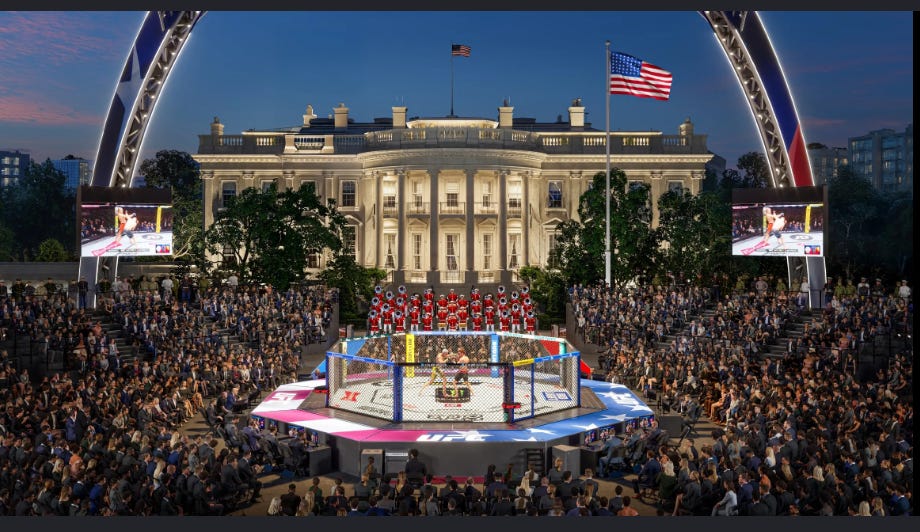
Everybody knowsThere are moments in American political life when a single image captures the current terrain. This is one of them. It was not a policy document, not a diplomatic summit, not even a crisis unfolding overseas. It was a steel mesh UFC cage where men would beat each other bloody, rising on the South Lawn of the White House—a spotlighted octagon of violence as spectacle assembled where generations of presidents once hosted Easter egg rolls, treaty signings, and state dinners.
The cage was not an accident. It was not a sideshow. It was the show. Leonard Cohen’s “Everybody knows”, written decades ago, has become the unofficial anthem of our age—not only because it uses gallows humor to expose cynicism, but because it also describes the precise emotional terrain in which modern politics now operates. It names the feeling that the system is rigged, that corruption is visible yet unmovable, that the public sees everything and believes nothing.
The upcoming White House cage fights are not simply stunts. They are a culmination—a perfect fusion of Guy Debord’s Society of the Spectacle and William Chaloupka’s ‘Everybody Knows’ exposing the politics of cynicism. It is the moment when power stops pretending to be dignified and instead revels in its own absurdity. It is the moment when the state becomes a stage, and the stage becomes a dare: You see what we’re doing. And what are you going to do about it?
Debord and the French Situationists of the 1960s warned that in a society dominated by images, the image becomes the real. Politics becomes performance; citizenship becomes spectatorship. The cage on the South Lawn is the purest expression of this logic. It collapses the boundary between governance and entertainment, between the Oval Office and pay per view. The message is unmistakable: Politics is a fight. Power is a show. Democracy is a backdrop.
The $400 million ballroom-funded by billionaire donors and built atop the rubble of the East Wing-extends the same logic. It is not a civic space; it is a set. A gilded stage for the wealthy to mingle under chandeliers while cameras pan across the room, capturing the Great Gatsby glamour of proximity to power. The proposed 250-foot “Independence Arch,” shimmering gold and visible for miles, is the architectural equivalent of a loud shout. It does not commemorate history; it overwrites it. It declares that appearance is truth, that scale is legitimacy, that spectacle is sovereignty.
In Debord’s terms, these projects are not deviations from governance-they are governance. They are the means by which power communicates its dominance in a society where paying attention is the most valuable currency.
But the spectacle alone is not enough. It requires a psychological partner. It requires a public that sees the absurdity and shrugs. It requires the politics of cynicism.
William Chaloupka argued that modern cynicism is not rebellious; it is pacifying.In effect, It plants a “little cop” in our minds who constantly whispers two lies:
1. Nothing ever changes.
2. You have no power.These lies are the perfect complement to the spectacle. The spectacle dazzles; cynicism immobilizes. The spectacle shocks; cynicism shrugs. The spectacle demands attention; cynicism insists that attention is pointless.
This is why the Trump regime does not hide the transactional nature of the ballroom or the theatricality of the cage fight. The brazenness is the point. The transparency is the weapon. When critics object, the response is a smirk, a shrug, a line like Joe Rogan’s “Life is a gimmick.”
The message is clear: Of course this is absurd. Everything is absurd. You already knew that. Cohen’s refrain-“Everybody knows”-becomes not a lament but an exposed strategy of domination. If everybody knows the system is rigged, then nobody expects anything better. If everybody knows corruption is inevitable, then corruption becomes normal. If everybody knows politics is a circus, then the circus becomes governance.
Cynicism, once a tool of resistance long ago, becomes a tool of autocratic power. When spectacle and cynicism merge, they form a closed loop: Trump unveils a shocking project, we respond with outrage, the media uses us to amplify the spectacle, those in power respond with cynicism and its evil twin, divisive structures of white and male dominance, too many of us then sink into apathy, into our enclosed media bubbles, and the cycle resets. Rinse. Repeat.
This loop is not accidental. It is engineered. It is the operating system of contemporary politics. And yet, beneath the cynicism, a deeper truth persists—one that the spectacle works tirelessly to obscure.
Cynicism tells us nothing changes. But history tells us the opposite. Everything changes. Everything is always changing. The civil rights movement, the labor movement, the women’s movement, the environmental movement—none of these partial victories were inevitable. They were the result of collective action, and expansive solidarity, and a public imagination growing more radical by the day.
Cynicism tells us we have no power. But our solidarity is power. Collective action is power. The ability to imagine a world beyond the spectacle is power. We saw it in Minnesota, in the New York City elections, in ‘No Kings, No Ice, No Wars’ everywhere, and more.
The question is how to make these deeper truths visible again and again-how to turn them into a counter spectacle strong enough to break the loop. To defeat the spectacle, we cannot rely solely on traditional protest. The spectacle absorbs outrage. It feeds on it. It thrives on predictable opposition.
Instead, we must expand traditional tactics by drawing on a few older archetypes-figures of a dynamic quality who operate outside the spectacle’s logic: the joker, the trickster, and the shaman.
The Jokester uses satire not to mock from the sidelines but to puncture the illusion of inevitability. Humor is a solvent. It dissolves the aura of power. As blown up costumes of frogs, clowns and unicorns, the Jokester turns the White House cage fight into a circus poster, or stages a clown referee brigade outside the gates, the spectacle loses its intimidation. It becomes silly. And once power looks silly, it loses its grip. Humor is not frivolous. It is a weapon.
The Trickster then comes into play. It does not fight the spectacle head on. The Trickster jams its gears. Through malicious compliance, procedural overload, and strategic mimicry, the Trickster exposes the vulnerabilities behind the spectacle’s façade.
If the MAGA regime builds a 250-foot arch, the Trickster files thousands of historic preservation claims for the soil beneath it. If the spectacle relies on televised drama, the Trickster buys ad space to air dry readings of zoning codes. The Trickster reveals that the machinery of power is clumsy, but not omnipotent. Disruption is not chaos. It is part of our strategy to build strength in a war of position.
The Shaman is one of our antidotes to isolation. The spectacle separates people; the Shaman gathers them. The spectacle demands passive consumption; the Shaman calls out and creates an active community. The spectacle is televised; the Shaman is living.
Imagine, on the night of the White House gala, thousands of local community centers hosting oppositional-from-below public banquets, mutual aid gatherings, storytelling circles, street art expositions—just the people on your block, or in your workplace or school, face to face, rediscovering the power of solidarity.
Community of this sort is not nostalgia. It is resistance. When the Jokester, the Trickster, and the Shaman work together, the “little cops” in our brains lose their authority. The lies collapse. The deeper truths emerge: Everything changes. We have power. Solidarity is stronger than spectacle. Community is stronger than cynicism. A fiery imagination is stronger than cynical inevitability.
The spectacle wants us to believe that politics is a cage match, that democracy is a stage, that citizenship is a spectator sport. But the truth is deeper and sturdier: an abolition democracy is a practice. It is a habit. It is a relationship among people who refuse to give up on one another.
The blood sport cage on the South Lawn is not the future of our country. It is a mirror held up to a moment of profound disorientation. But mirrors of spectacle can be shattered. And when they break, they reveal the dynamic world behind them—a world still full of possibility.
Leonard Cohen was right that “everybody knows” the system is rigged. But he also knew something else, something both softer and stonger, something the spectacle cannot understand: that beneath the cynicism, people still long for meaning, for dignity, for connection, for justice. We think of Cohen’s other tune, ‘Democracy is Coming to the USA:
It’s coming from the sorrow in the street
The holy places where the races meet
From the homicidal bitchin’
That goes down in every kitchen
To determine who will serve and who will eat
From the wells of disappointment
Where the women kneel to pray
For the grace of God in the desert here
And the desert far away
Democracy is coming to the U.S.AThe spectacle cannot satisfy that longing. Cynicism cannot extinguish it. And once that longing becomes visible—once it becomes shared—it becomes unstoppable. The cage is not the point. The point is that we can break through its walls and walk out of it. Challenge that ‘little cop in your head. We start by emancipating our minds from the old muck of cynical “common sense” and thus fostering the growth of “good sense,” breaking the chains of spectacle and beginning a new order.
[All LeftLinks editorials, unless otherwise designated, express the views of our stalwart editor, Carl Davidson, and not necessarily any organizations he is connected with. Everyone, of course, is welcome to steal them and shamelessly pass them around, far and wide, with or without permission. A thank you note would be welcome, though!]
I thanked Carl Davidson in the title of my post. Reading this again made me even more grateful for his reminder not to succumb to the "little cop" of cynicism.
Thank you for this Alice. Chilling, but also encouraging.