
Many Rivers to Cross
Finding Our Way

Many rivers to cross
But I can’t seem to find my way over
Jimmy Cliff crossed over that final river. He passed away in Jamaica on November 24, 2025 at the age of 81. He wrote “Many Rivers to Cross” in 1965 and the song was featured in the movie The Harder They Come in 1972. I saw that movie in San Francisco where the reggae music and its outlaw message resonated deeply. Some of those in the audience with me were probably living under assumed names in the early 70s.
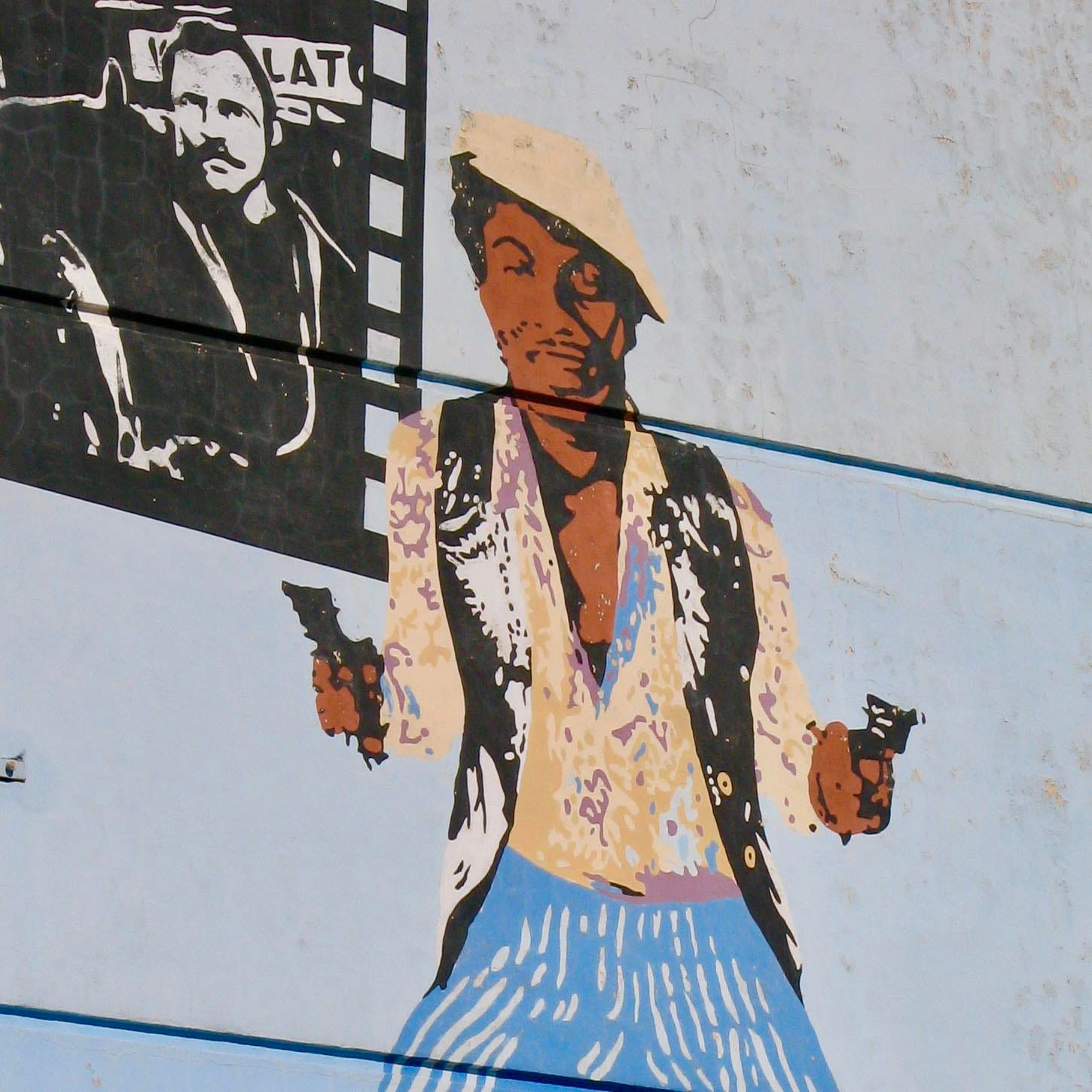
My husband Carlos Lowry painted Jimmy Cliff’s image onto the Varsity mural at 24th and Guadalupe in 1980. A towering Jimmy Cliff brandishing guns is visible for a block or more as you travel north on Austin’s “Drag.”
The Varsity Mural
The Varsity mural has been something of a family affair for decades. Carlos painted it the year we were married as a project of Interart-Public Art. He projected images onto paper and then transferred the image outlines with blue chalk dust onto the massive wall. The movie images stretched across an entire block. The references to films can be viewed at this site.
As with much of Austin, the mural is no longer what it was in the 70s and 80s. When Tower Records bought the Varsity Theatre in 1990, a petition campaign preserved it. The owner of Tower Records returned from vacation to find pages of Austin signatures and letters from elected officials spilling from his fax machine onto his carpet.
As our daughter wrote on Facebook, it has not survived the turn of the century in tact:
It’s been mutilated, but they preserved parts of it (including Jimmy Cliff). My dad was not part of the preservation, so some parts were moved/redone by other artists. There’s now a CVS and Wells Fargo in the building, so the most obvious part of the mutilation is that the lower part of the wall is full of windows and corporate signage. Recently, a scene from Linklater’s Slacker was also added as a new film frame by other artists.
The detail at street level, didn’t make it. It was photographed repeatedly by Daily Texan, Austin American Statesman, and Austin Chronicle photographers and by passersby. But, it’s gone. Below is what it looked like when Greta Garbo, Humphrey Bogart, Marilyn Monroe and the Fellini clown band were at the centerpiece. The design features of spotlights are still intact.

We’re losing much of what made Austin weird and wonderful in the 60s and 70s. High rises replace haunts. I’d be happier if the high rises provided affordable housing.
I read remembrances of Robert Redford when he died this year. He was asked in one interview what he thought about dying. “It’s part of the package,” he said. And indeed it is.
I’m not trying to wax nostalgic for an Austin long gone, but I do feel the urgency to account for the history of the 60s and 70s. Get the material archived, capture the oral histories, and write it down. And acknowledge the dearly departed.
Larry Caroline
Larry Caroline passed away on November 7, 2025. He was 85. In 1967, as an assistant professor of philosophy Larry Caroline gave a speech at a rally against the war in Vietnam in 1967. He lost his teaching position. The parallels with Tom Alter, fired from Texas State University in 2025 are chilling. We can, of course, Defend Tom Alter. We can also honor the memory of Larry Caroline.
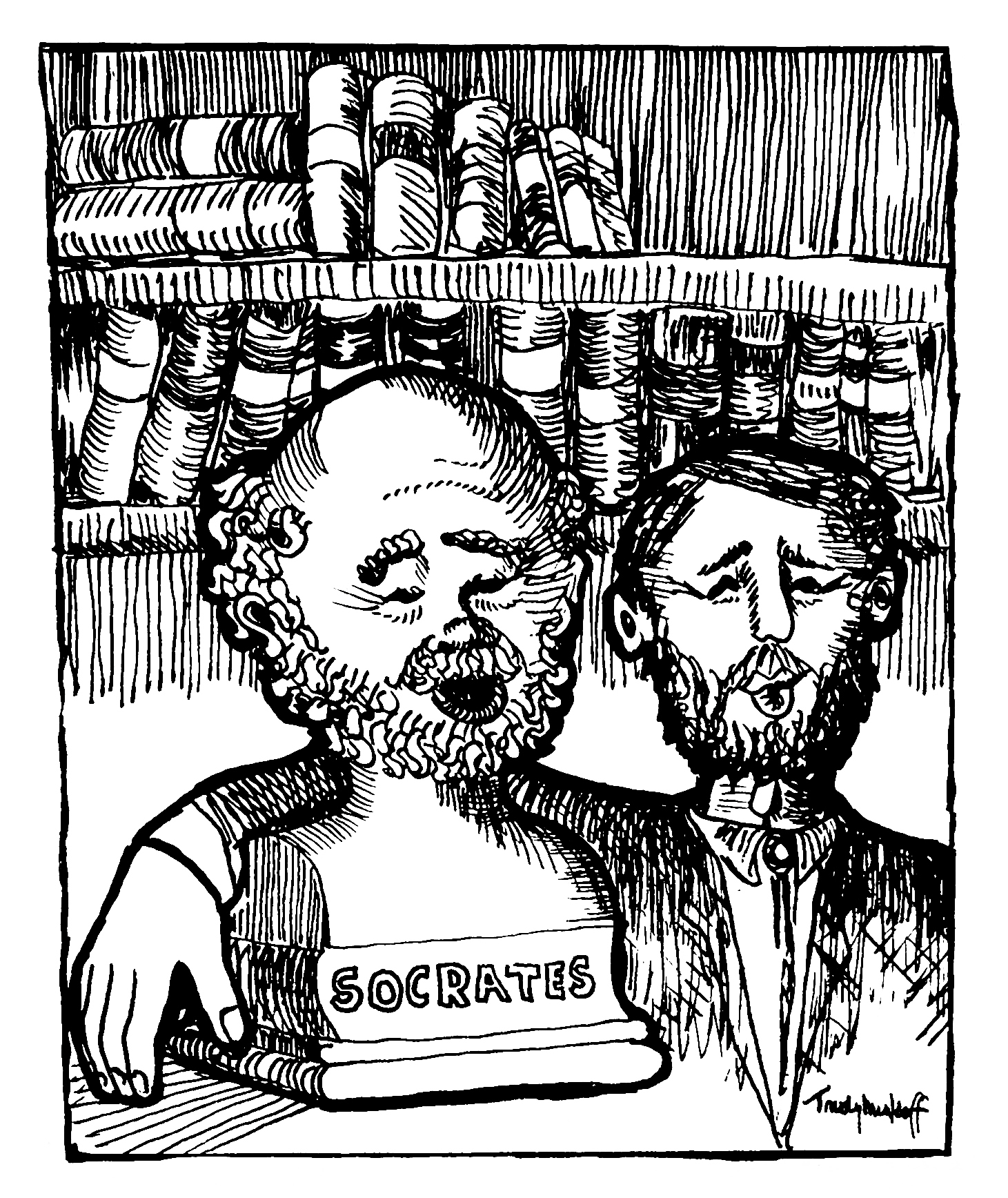
Martin J. Murray, author of Insurgent Politics in the Lone Star State, wrote a tribute to Larry Caroline posted at The Rag Blog, “Larry Caroline Disarmed Critics Without Demeaning Them.”
An obituary shared by Larry Caroline’s family recounts his early life:
Born in upstate New York, Yisrael (Larry) grew up in a Yiddish-speaking home that valued Jewish identity but was not observant. The experience of facing discrimination as a Jewish child awakened in him a lifelong drive to stand up for those who were mistreated.
While studying philosophy at the University of Rochester, he became president of the NAACP chapter and a leader in the campus movement for civil rights. He organized protests against racist fraternities and became an outspoken advocate for equality and peace. His early ideals, deeply rooted in justice and moral clarity, shaped his work as a professor and public speaker.
After earning a fellowship from the Woodrow Wilson Foundation, he taught at Kentucky State College during the civil rights struggle. Later, as a professor at the University of Texas, he became known for his passionate opposition to the Vietnam War. His remarks at a protest rally, calling for “a revolution” to end the war, made front-page news across Texas and ultimately led to his dismissal from the university.
May Larry’s wisdom and courage be remembered. May his memory be a blessing to all who were touched by his life.
Spinning Blue Ball by Gavan Duffy
We’re living on a spinning blue ball
Every winter, spring, summer, and fall
How lucky we are to be circling a star
Living on a spinning blue ballWe’re hurtling through time and through space
The whole wide human race
Each one’s so small on our blue ball
Hurtling through time and through space
Earl Gavan Duffy, Professor Emeritus at the Maxwell School of Citizenship and Public Affairs at Syracuse University, died on September 6th in Syracuse, New York. He was 75 years old. He was well known in Houston and Austin during the 60s. The Rag Blog posted this tribute to his life, “Gavan Duffy was a scholar with a sense of humor.”
Gavan was also a musician. I encourage everyone to listen to Spinning Blue Ball on Youtube. Gavan’s lyrics and music put departures into perspective the same way Robert Redford did.
Departures To Celebrate (DOGE)
Mother Jones advice comes to mind. The venerable union organizer said, “Pray for the dead and fight like hell for the living.” DOGE is dead. Pray for the living.
Timothy Noah published his non-eulogy for The New Republic on November 25, 2025, in time for Thanksgiving. Here are some snippets.
Can one eulogize a federal agency that never existed? The question has the quality of a Zen riddle. But Reuters informs us that the phantasm known as the Department of Government Efficiency, a.k.a. DOGE, n’existe plus. “That doesn’t exist,” Office of Personnel Management, or OPM, Director Scott Kupor told Reuters’s Courney Rozen when Rozen inquired about DOGE’s status.
In fact, DOGE never existed—not as a government agency, anyway. Only Congress can create a government agency. Trump took a White House office called the U.S. Digital Service, fired a bunch of its employees, and renamed it DOGE. It operated as part of the White House Office of Management and Budget, whose director, Russell Vought, (as I explained in June) called most of the shots.
DOGE’s supposed North Star was taxpayer savings, but by that yardstick it was a dismal failure. Elon Musk, the billionaire ketamine fancier who ran DOGE through May as a time-limited special government employee, predicted up front that he could cut “at least $2 trillion” from the $7 trillion U.S. federal budget. Then he said $1 trillion. Then he said $150 billion. Today DOGE claims $214 billion in savings, but even if we accept that at face value (probably unwise), it doesn’t take into account the $135 billion that Max Stier, president of the Partnership for Public Service, estimated DOGE’s disruptions cost the government in lost productivity, paid leave, and the rehiring of workers fired mistakenly. Add in cuts to the IRS, which reduce rather than increase revenue, and DOGE’s cost rises to $458 billion. When you combine that with DOGE’s claim to have saved $214 billion, that nets out to an operating loss of $244 billion. Cutting waste, fraud, and abuse is very expensive!
Humor is Sustainable
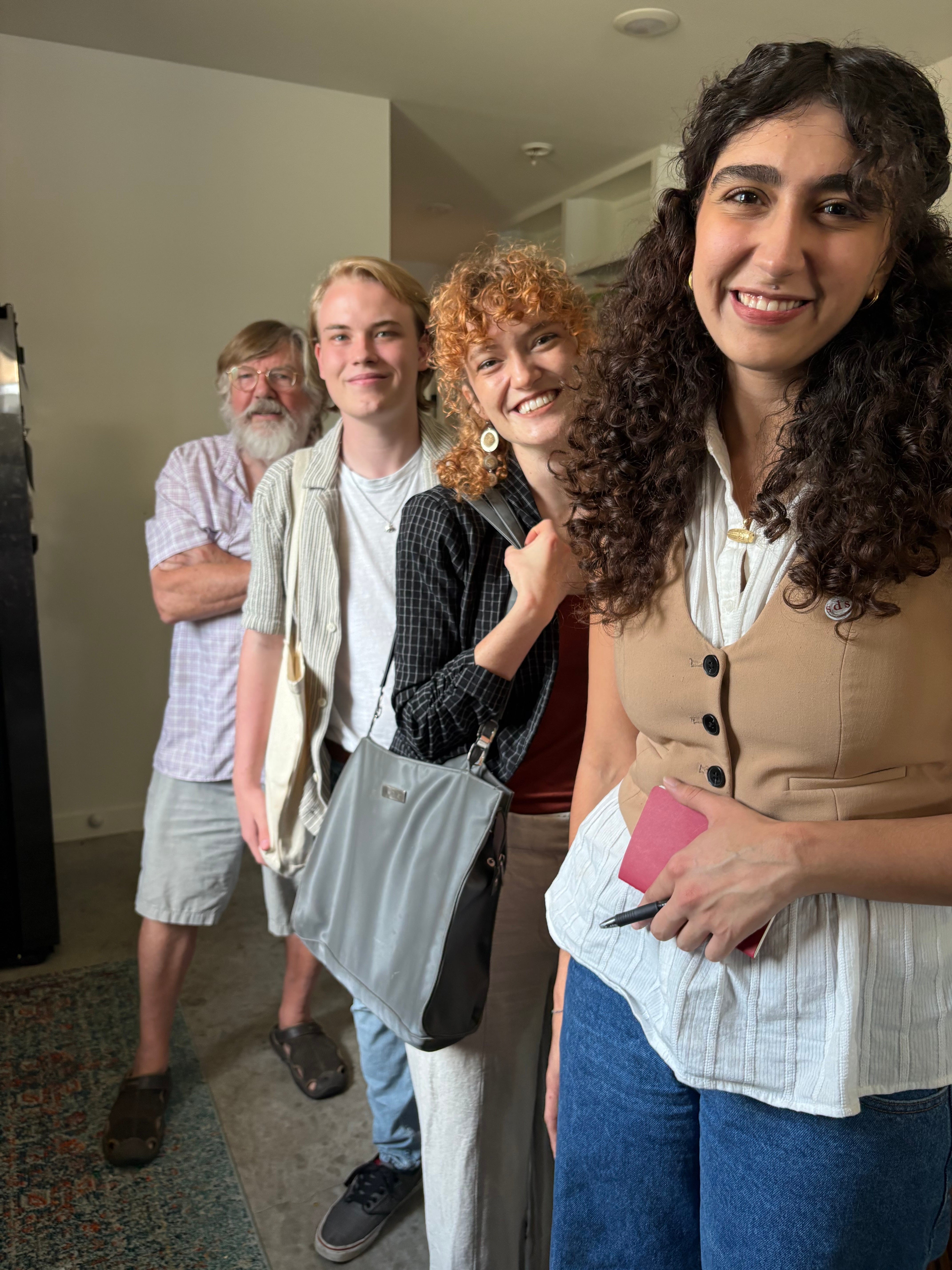
The new Rag — a monthly zine on the University of Texas at Austin campus — is getting a lot of media attention. Colleague Thorne Dreyer writes about it at The Rag Blog in his post, “Central to the new Rag’s voice is to retain the levity of the original.”
Since editors Ava Hosseini and Kira Small -- with the help of managing editor Grant Lindberg -- started their seemingly modest endeavor to resurrect the underground newspaper, The Rag, that we published from 1966 to 1977 in Austin -- ancient history, to most of you -- their new zine, also tagged “The Rag,” has taken off like few could have imagined.
This week I’ve seen front page feature stories and meaty thought pieces about the importance of this new journalistic upstart. “Disillusioned UT seniors choose satire as a salve,” headlined the Austin American Statesman. With the subhead: “Pair revives 1960s publication forged in a similar fraught era.” “Counterculture magazine revived after nearly 50 years,” added The Daily Texan.
The head on an article in the San Antonio Express-News reads: “Disillusioned by UT, seniors choose humor over outrage -- and revive 1960s-era newspaper.” “Why UT Students Are Reviving an Underground 1960s Newspaper,” headlined Texas Monthly in a substantive feature article — then, as a subhead, added, tongue firmly in cheek: “Instead of stalking our ex-boyfriends online, we started a newspaper.”
Some of The Rag’s founders, now nudging their 80s (don’t tell them I told you), offered encouragement and nuts and bolts advice, especially my colleague Alice Embree…
“Central to The Rag’s voice is its commitment to retaining the levity of the original — something that seems to come naturally to Hosseini and Small, “wrote Texas Monthly’s Sasha von Oldershausen. “Anger burns really quickly,” Small told her, “Humor is more sustainable.”
"Sittin' here in Limbo, waiting for the dice to fall..." RIP Jimmy Cliff, Gavan Duffy, Larry Caroline, and the other Freedom Fighters we've lost along the way -- and Welcome! to the young Freedom Fighters replenishing our ranks. The only way to go is Onward -- L'Chaim!